
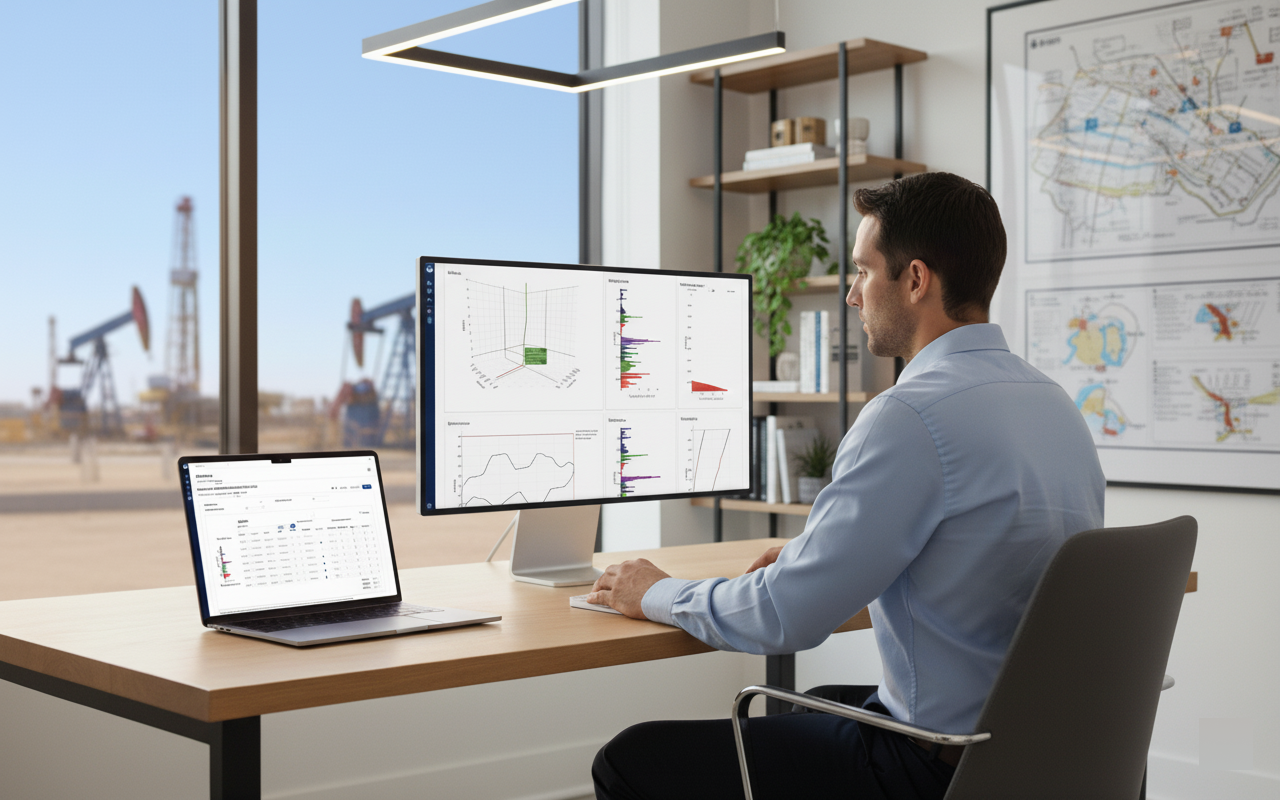
What 100x Wellbore Resolution Actually Shows You
What 100x wellbore resolution actually means: more calculation points, sharper side load peaks, resolved stress concentrations, and guide placement you can act on.
PetroBench 2.0 - Global units, version control, multi-language support and more.PetroBench 2.0 is hereSee what's new

How cubic spline interpolation and configurable step length improve side load and stress predictions in deviated wells compared to linear methods.
Deep technical understanding of rod lift mechanics
What 100x wellbore resolution actually means: more calculation points, sharper side load peaks, resolved stress concentrations, and guide placement you can act on.
At 50-ft resolution, tight doglegs fall between calculation points. Side loads get averaged out, rod guides land in the wrong spots, and failures repeat.
How the base case promotion workflow in multi-scenario comparison transforms rod string design from single-point evaluation into systematic optimization.
How 3D wellbore visualization with interactive dogleg severity, inclination, and loading overlays changes the way engineers make rod guide placement and taper transition decisions.
Where rod-on-tubing contact happens, why standard DLS thresholds miss it, and how simulation helps you place guides correctly.
A technical comparison of minimum curvature, linear, and cubic spline interpolation methods for directional surveys in rod pump simulation, with quantitative examples of how each affects predicted rod string loads.
When sinker bars help your rod string reach bottom in deviated wells, and when they create more problems than they solve.
A rod string designed for commissioning day conditions will not be optimal two years later. Here is how to design for the full lifecycle.
Educational comparison of card types. What each shows, limitations, and when to use which for diagnostics.
A complete technical reference for dynamometer card analysis covering wave equation fundamentals, diagnostic patterns, and practical field workflows.
A 50-foot step can miss the exact curvature that causes failures in deviated wells. Here is what the research says about getting it right.
Talk to our engineering team about your rod lift design workflow.